
Written By Jeffrey Cartwright, Managing Partner
Chinese Foreign Direct Investment in Mexico Had Been Anemic until Late in 2025
Total Foreign Direct Investment in Mexico has averaged near $35 billion annually. Many announcements have been made concerning the opening of Chinese factories, but the reality prior to late 2025 is that Chinese FDI has been less than 2% of total FDI from other countries. The largest investing country has been the United States and continues to be. However, with the second Trump administration increasing tariffs on China, coupled with the prior Biden administration increasing tariffs rather than reducing them, it seems that tariffs are here to stay. In fact, one of the few areas of agreement between Democrats and Republicans is that China is an existential economic threat. That, plus tariffs are a source of revenue for the United States government.
As a result of these tariffs and perhaps pressure brought by US customers of Chinese companies, there has been a dramatic increase in the number of factories being built in Mexico by Chinese firms.
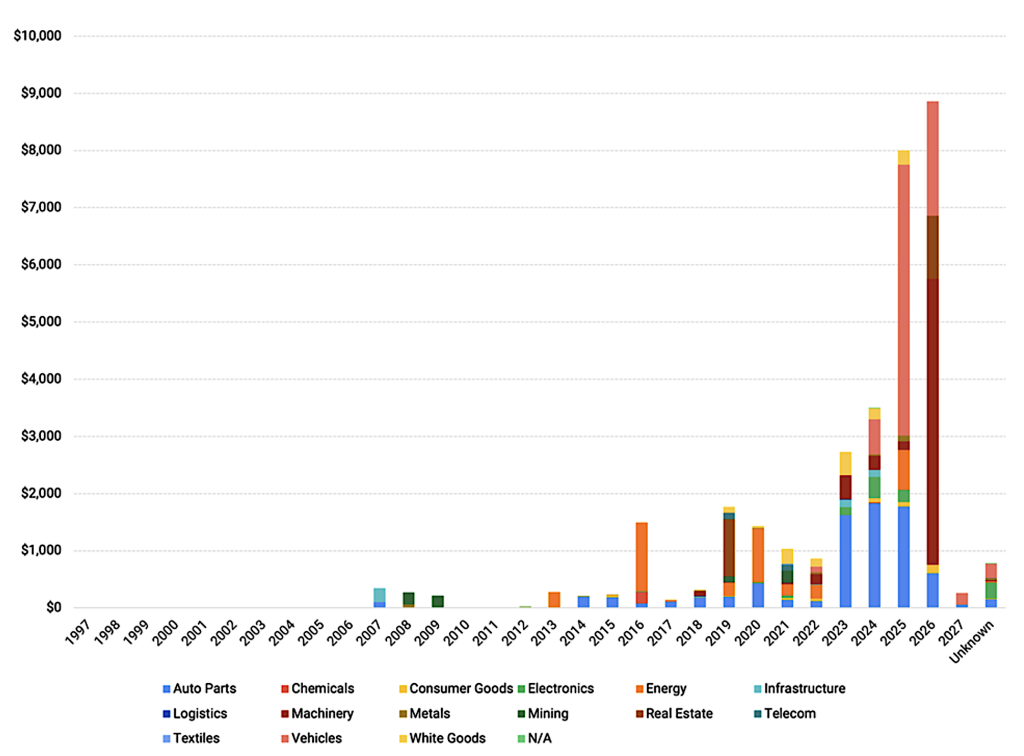
Source: Collins Research Portal. Powerful New Data and Insights on Investments in Mexico by China-Linked Entities. March 4, 2025. https://collinsresearchportal.com/2025/03/04/powerful-new-data-and-insights-on-investments-in-mexico-by-china-linked-entities/
The Benefits to Mexico from Chinese Investments
Any new factory in Mexico brings new jobs to Mexico. Increased formal employment brings tax revenues, as do the profits that the new business generates. Additional salaries for higher level staffing in such areas as engineers, quality control management, and factory leadership are also positive for the same reasons. Real estate development and construction are also positive.
Purchases of commodities such as steel, resin, corrugated packaging, and other base materials also occurs and provides some new jobs with existing Mexican factories.
The potential of a cluster of supporting factories is also promising, but for this increased investment, it is too early to see a second round of investment.
Real Competitive Advantages of Chinese Factories Operating in Mexico for US Importers
There are significant advantages to a US client importing from a Chinese contract manufacturing factory operating in Mexico. These include:
- Knowledge of US products (that historically have not been manufactured in Mexico) and manufacturing processes to manufacture these products with costs similar to China production.
- Avoidance of 301 tariffs that the US has on Chinese imports (as long as the majority value-added content is Made in Mexico).
- Shorter lead times which result in less inventory overall.
- Speed of quotation process which is one to two weeks in China and sometimes several months in Mexico. Also, quotations in Mexico tend to start high with decreases over multiple rounds with multiple vendors, whereas quotations from China tend to be much more competitive on the first bid. The Mexican business culture is entrenched, and this has made it difficult for factories to provide more competitive first-round quotations and to provide a much faster quotation process.
- Proximity to the United States for travel for factory visits and for ease of meeting as Mexico and the US are in the same or nearly the same time zone.
- Clearer communications with many bilingual engineers and managers in Mexico and the US.
- Product development resources in China, while manufacturing in Mexico, which allows US clients to have less product development resources on their staffs in the US.
- Provision of the entire bill of materials. This is different between Mexico, which is more of an intermediate goods producer that sends parts to another factory, and China, which is more of a finished goods producer. In China, the factory will quote the entire bill of materials whereas this is rare in Mexico and the client or a sourcing firm like Shoreview must assemble the bill of materials from different factories.
Backlash in Southeast Asia from Investment by Chinese Factories Suggests that Mexico Will Also Be Disappointed
Southeast Asia has seen over $126 billion in Chinese investment in the last decade. According to a March 26, 2026, article in Foreign Affairs, what once seemed like a path to shared prosperity now feels like a dead end. China is suffocating the very economies that it promised to lift.
While there is additional employment in Vietnam, Thailand, and other countries, it is largely confined to assembly or low-skilled workers. The manufacturing of higher-value-added components remains in China. As China is relatively close, these are shipped into Southeast Asia. There are several reasons for this lack of higher-skilled manufacturing remaining in China:
- For the Chinese Communist Party to maintain power, it must increase the economic well-being of its people. Its biggest fear has been social unrest caused by unemployment. Youth unemployment (defined as age 25- to 29-year-olds) is at 7.7% – a recent high, and unemployment for those younger (age 16 to 24) is at 17%. Unemployment for the population overall has up-ticked with factory wage income declining since the start of the trade war.
- Setting up factories elsewhere is to avoid tariffs, not to serve local markets. Often, the product will cost more to manufacture in Vietnam or Thailand (10% to 15%) due to the added logistics cost of moving components and materials from China and due to lower worker productivity in these factories. Additional costs are incurred due to the high number of Chinese engineers and factory leaders brought in from China to staff these factories.
- The net result is that the minimum amount of work is performed and the minimum amount of local content is purchased in order to claim “Made in Vietnam” or “Made in Cambodia”.
In short, the Chinese have overpromised and underdelivered on the benefits of manufacturing in these countries.
The Belt and Road Initiative ,launched in 2013 by China into many countries, has yielded a similar result. Chinese construction workers, Chinese control, and Chinese profits with limited benefit to the host country.
It is important to distinguish between Chinese owned factories (mainland China), whose ultimate loyalty is to Beijing and whose executives may incur severe penalties by not adhering to the CCP strategies, and other factories owned by Taiwanese or other overseas Chinese. These latter companies are motivated by profits and have no requirement to adhere to Beijing directives.
Chinese Factories Will Not Save the Mexican Economy
The above will be, and so far, has been the case, with Chinese factories that are or will be operating in Mexico. Add to this, the Chinese do not believe that Mexico (despite being a manufacturing, export-oriented economy with higher exports into the US than China) has developed the manufacturing capabilities required to be a source of competitive components and materials. While this is true for many items, it is not universally true. But when the Chinese factory makes little to no effort to join the Mexican business culture by engaging locally to identify and develop suppliers and the relationships that are required to do business in Mexico, it is a self-fulfilling prophecy. These components will be manufactured in China, as it supports the overall Chinese Communist Party mandate to remain in power by providing employment rather than risk social unrest.
There will be an increase in factory employment in Mexico. These Chinese factories will be more cost-competitive than existing Mexican factories. Many companies in Mexico will struggle to compete, lose volume to the lower cost competitor factory and many companies will shut down as a result. These companies will lose because the Mexican business culture is complacent and will not invest in the value-added components that will be imported from China, such as fractional motors, lithium-ion batteries, chargers and power cords, light bulb sockets, and many other components that are required to manufacture a complete, finished product.
Mexico will be disappointed that it has allowed its existing companies to be destroyed by competition from Chinese factories that it is inviting to invest today.
Executive Summary
Chinese companies are now setting up operations in Mexico, which allow them to take advantage of the lower tariff regime. However, it is apparent that Chinese companies want to retain as much manufacturing of the product in China as possible to provide employment to the maximum number of Chinese factory workers. This works well when the content exceeds 50% through value-added operations and localized content. The issue is that China will provide the minimum level of investment and jobs to accomplish this. There is also the risk that there will be attempts to claim compliance while substantially importing more skilled labor or components and raw materials from China.
Shoreview has operated extensively in both China and Mexico for decades. By leveraging these experiences, we are able to bridge cultural differences and have delivered successful results in the majority of Nearshoring projects over the last 8 years. Our ability to sense potential issues and resolve them before serious difficulties arise is unique to Shoreview. Many importers are unaware of these differences and trust that the way business is done in China is the way business is done in Mexico, and that is simply not always the case. Ronald Reagan said it well when he said, “Trust, but Verify”.